JOINT PRESS RELEASE
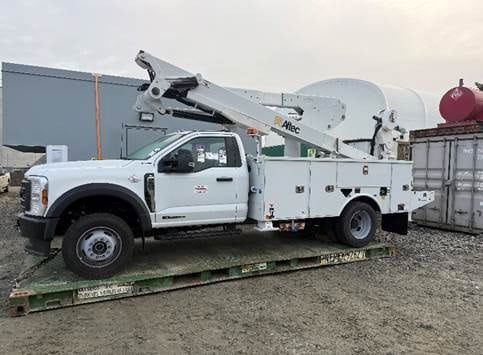
Village of Solomon partners with Nome Joint Utility System to improve power outage response with new bucket truck purchase under the GRID Resilience program, led by Native Village of Council
Village of Solomon (VOS) has partnered with local electric utility, Nome Joint Utility System (NJUS) to purchase a new bucket truck for the utility in order to increase their local capacity to respond to power outages, emergency repairs, and general maintenance. Village of Solomon is part of the Bering Strait Grid Resilience Group Consortium, which is managed by the Native Village of Council as the lead Tribe. Both Tribes have local offices in Nome, Alaska. There are sixteen Tribes and Native Corporations who are part of the consortium group, with over $2.7 million available to use for local grid resilience projects.
The collaboration of VOS and NJUS is a great example of how Tribes can work with local energy utilities to access funding and increase capacity in communities where tribal members live and work. The project utilized the Grid Resilience State and Tribal Formula Grants Program, also known as the 40101d program established by the Department of Energy in 2021. All Federally Recognized Tribes and Native Corporations were eligible to apply for allocation funding over a five-year period. The funding allocations must be spent in partnership with an eligible entity, such as a local utility or fuel company, with required project cost share, depending on the type of entity and type of project.
“We are really excited to see this partnership come together. As Tribal governments, we have opportunities to bring federal resources into our region and find ways to make those investments benefit our communities as a whole. This project is a great example of what can happen when we work together, share resources, and focus on the needs of our community. Having reliable equipment to respond to power outages and emergencies is incredibly important, especially in rural Alaska. We are proud to have played a role in making this happen and look forward to continuing these partnerships,” said Deilah Johnson, Tribal Resources Director, Village of Aŋuutaq (Solomon).
To date, the Village of Solomon is the only Tribe within the consortium group that has begun to spend out their allocated funding. Many other Tribes and Native Corporations have projects in pre-development stage and are planning to spend out their allocated funding in the upcoming years.
Thomas Simonsson, the Field Operations Superintendent at NJUS said, “We sincerely appreciate the Village of Solomon’s partnership and their support in making this purchase possible. When the power goes out, it’s our friends, families, and neighbors who are affected, and our crews work hard to get everyone back up and running as quickly and safely as possible. Having the right equipment makes a real difference in how we do that. This new bucket truck is an investment in our community that will serve Nome for many years to come. We’re grateful to the Village of Solomon for working with NJUS to help us better serve the community we all call home.”
Overall, the Grid Resilience funding is a chance for Tribes and Native Corporations to partner with local energy entities to enhance their utility grid, improve infrastructure and equipment to respond to power outages, provide workforce development and training opportunities, improve local fuel storage, and other eligible projects. Nome-based Tribal entities have gathered for many meetings over the past year to discuss potential opportunities for partnership with NJUS. The utility bucket truck project is one of those opportunities.
Kawerak’s Energy Program provides technical assistance and project development support to the Tribes and Native Corporations in the Grid Resilience consortium, and assists the lead Tribe with the management of grant activities. Kawerak also assists with hosting meetings for the consortium group and sharing regular updates.
The final allocations for the 40101d program FY25-FY26 were just released on October 20, 2026 by the Department of Energy; existing and new applicants have until February 17, 2027, to apply. Kawerak’s Energy Program is available to assist Tribal entities in the region with applications to the newly released round of 40101d funding. Reach out to [email protected] for more information.
For more information about the 4010d program, visit: Grid Resilience State and Tribal Formula Grant | netl.doe.gov
To reach out to the Bering Strait Grid Resilience Group Consortium, please contact lead tribe, Native Village of Council, PO Box 2050, Nome, AK 99762 907-443-7649.
For more information about the 4010d program, visit: Grid Resilience State and Tribal Formula Grant | netl.doe.gov
To reach out to the Bering Strait Grid Resilience Group Consortium, please contact lead tribe, Native Village of Council, PO Box 2050, Nome, AK 99762 907-443-7649.
Contact:
Rhonda West, Native Village of Council, Tribal Coordinator, [email protected]
Deilah Johnson, Village of Solomon, Development Coordinator, [email protected]
Thomas Simonsson, NJUS, Field Operations Superintendent, [email protected]
Danielle Sem, Kawerak Inc., Outreach Director, [email protected]