MEDIA ADVISORY
FOR IMMEDIATE RELEASE
Thursday, March 5, 2026
Contact: Danielle Sem, Kawerak Inc., Outreach Director
[email protected], (907) 443-4344
Kawerak region Tribal voices call for meaningful action on chum bycatch
The North Pacific Fishery Management Council (NPFMC) recently met to take final action on management strategies to limit chum salmon bycatch in the Eastern Bering Sea pollock trawl fishery. Since 2011, chum bycatch has averaged approximately 250,000 fish per year. In the conservation corridor, chum salmon bycatch has averaged approximately 164,000 fish per year. (This number includes western Alaska chum salmon, Gulf of Alaska chum salmon, and Asian hatchery chum salmon). Currently there is no requirement to cap the number of chum caught as bycatch. Many thousands of those bycaught chum were bound for western and interior Alaska, where communities have been facing impacts to subsistence fishing, including recent moratoriums in some regions.
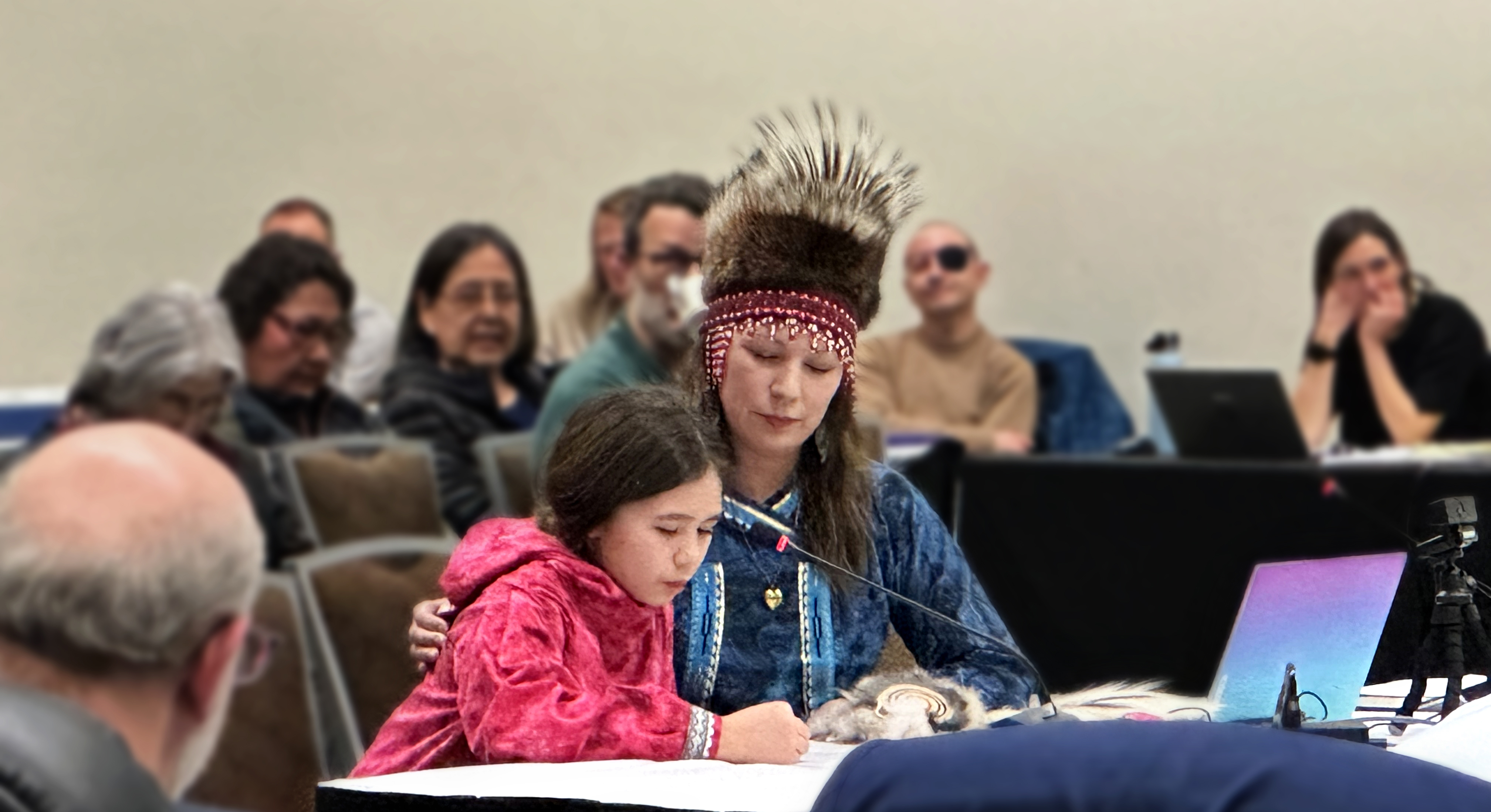
The vast majority of the nearly 200 testifiers at the NPFMC meeting were rural Alaska residents and representatives from Tribes, fish commissions, and Tribal regional nonprofits, including Kawerak, Inc. To assure that regional voices would be heard and representation witnessed, Kawerak provided travel scholarships to 12 regional residents to attend and testify in person at the meeting. Many testifiers from the Kawerak region and beyond spoke of the impacts of declining chum salmon runs on their food security, health, culture, and traditional ways of life. They provided overwhelmingly unified support for strong action that would meaningfully reduce chum salmon bycatch in the pollock fishery.
Darlene Paqpaluk Trigg, Executive Vice President of Kawerak, provided testimony on Kawerak’s behalf and shared:
“In our world, salmon are not just a commodity. They are not simply a number in a harvest report, a variable in an impact analysis, or a number which affects profit/loss statements. Salmon are a relative. They are a responsibility.
While our families face closures, restrictions, and hunger, the pollock fleet continues to waste thousands — and over decades, millions — of chum salmon through bycatch. The burden of conservation has been placed overwhelmingly on Tribal communities, while industrial fisheries continue to intercept salmon far from our rivers.
That imbalance is unjust, and it is a failure of the federal government’s trust responsibility and government-to-government obligations to Tribes. When chum salmon disappear from the rivers, it is not just a failed run. It is a break in our food system, our culture, and our responsibility to future generations.”
Management actions advocated for by Tribal organizations and many testifiers included a combined approach to reducing bycatch as much as possible. This combined approach called for: 1) a chum bycatch cap of 100,000 across the entire pollock fishery (where bycatch was on average 250,000); 2) a chum bycatch cap of 50,000 in a conservation corridor where most western Alaska chum are caught (where bycatch was on average 164,000); and, 3) putting into regulation a number of changes to industry measures which reduce bycatch. These ideas were analyzed in the Draft Environmental Impact Statement prepared by the NPFMC and National Marine Fisheries Service (NMFS). This combination recommended by many Tribal advocates would have resulted in a reduction by over 60% of western Alaska chum bycatch, allowing thousands of additional chum salmon to return annually to western and interior Alaska rivers.
However, the NPFMC’s final action fell far short of what was needed for salmon conservation and to meet subsistence needs, and what many testifiers requested. Instead of recommending a strong combination of alternatives with clear benefits to western Alaska chum salmon, the NPFMC adopted a motion that at its core represents the illusion of action. The NPFMC’s selected action had two main elements. First, the NPFMC supported turning current voluntary industry bycatch reduction measures into official regulation. Second, they recommended the implementation of a 45,000 western Alaska-specific chum salmon bycatch cap in the conservation corridor; exceeding the cap and failing to take action will result in portions of the corridor being closed in a subsequent season. This cap would also be turned off if Yukon River chum salmon reach a certain level of abundance.
Kawerak and subsistence users were advocating for more impactful regulation change. While at first glance, these actions appear promising, they are actually unlikely to protect western Alaska chum. Voluntary measures aren’t stringent enough, and since average annual western Alaska chum bycatch in the corridor is 31,000 chum, a 45,000 western Alaska chum limit allows for, and even potentially incentivizes, bycatch that is higher than the long-term average. Additionally, the NPFMC did not institute a hard cap on chum across the pollock fishery. This means that all of the chum bycatch outside the conservation corridor – which is approximately 40 percent of the bycatch – is not capped, and the closure of only portions of the corridor if the cap is exceeded means that bycatch can continue to accrue in known western Alaska chum hotspots. In total, this action can be seen as a step backwards from how things currently are, and as such, the NPFMC failed to take meaningful action to curtail chum salmon bycatch.
Although action did not reflect the priority and protection of subsistence users, Kawerak believes that the strong advocacy and effort of Tribal participants sent a powerful message to fishery managers and policy makers inside and outside of the federal fishery. Kawerak is grateful for the efforts and advocacy of regional subsistence users. The strong Tribal representation signaled that Tribal knowledge and voices will be heard in fisheries spaces. Kawerak will continue supporting and uplifting regional voices as well as advocating for regional Tribal positions on fisheries issues.
###
Kawerak, Inc. acts in accordance with its mission, to advance the capacity of our people and tribes for the benefit of the region. Kawerak is a nonprofit tribal consortium that provides over 40 different programs to the Inupiaq, St. Lawrence Island Yupik and Yupik people who reside in 16 communities of western Alaska and represents the 20 federally recognized tribes in the Bering Strait Region.